Course content
At speakeasy, we offer courses for all levels, ranging from beginner level A1 to advanced level C1. All our language courses align with the Common European Framework of Reference for Languages, which outlines the knowledge and skills required at each level. We are dedicated to assisting you in achieving your desired language level within this framework.
If you are uncertain about which level is suitable for you, don't worry! We provide a free placement test. If you remain unsure about your starting level after taking the test, we will gladly arrange a free placement interview with one of our teachers to help you determine the appropriate level.
Level Order
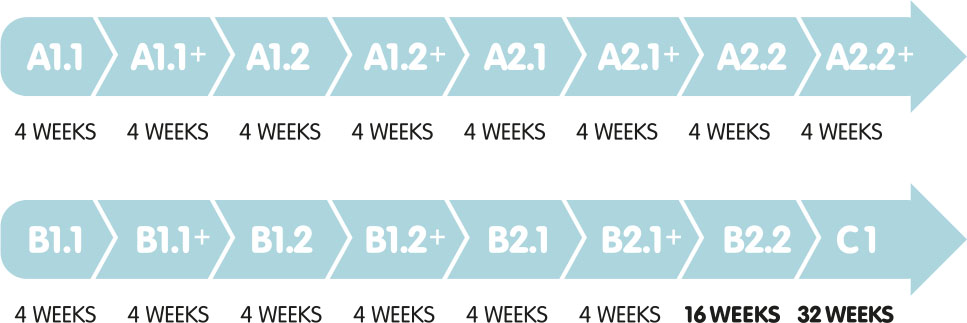
Wondering what the letters A, B, and C mean? It's simple: they indicate your proficiency level in German. Roughly speaking, A denotes beginner level, B denotes intermediate level, and C denotes advanced level - although the transitions between levels can be fluid. In our intensive courses, super-intensive courses, and evening courses, each of these levels is further subdivided into sub-levels, allowing for more targeted and personalized learning experiences.
For a simple overview of the level sequence, please see the chart below. The course progression is determined by the number of classes per course. In the intensive course with four appointments per week, you will progress twice as fast as in the evening course with only two lessons per week.
Intensive courses:

Evening courses:
The Content of Your speakeasy Courses in Frankfurt
It is not easy to assess your own language level. That's why speakeasy offers you a free online placement test. You can also use the following overview to personally assess your language level:
Are you new in Frankfurt and want to learn your first sentences in German? Then start your exciting German learning experience with the A1.1 intensive course.
The most important topics at a glance:
Vocabulary A1.1
Grammar A1.1
The A1.2 intensive course builds upon what you have learned in the A1.1 course. You will learn how to ask for specific information and become acquainted with many important aspects to use German in everyday life. For example, you'll practice how to make appointments with friends or with a doctor, how to book a hotel, or how to ask for help when you get lost.
Vocabulary A1.2
Grammar A1.2
Now you are an advanced beginner and can already master your first expressions in German! Would you also like to learn how to make an appointment or ask for something? If so, the A2.1 intensive course is the right German course for you.
The most important topics at a glance:
Vocabulary A2.1
Grammar A2.1
You are only one step away from B1 level! Now it's up to you: Continue diligently and learn how to express your own opinion and talk about exciting topics such as travelling and events!
Vocabulary A2.2
Grammar A2.2
Welcome to the B1 level! You already know some German, but would like to deepen your knowledge? Here, you will learn more complex topics and structures to expand your existing German skills.
Here you will find an overview of all the topics you will cover in the intensive course B1.1:
Vocabulary B1.1
Grammar B1.1
At this level your vocabulary includes more abstract topics. You can now talk about politics or art.
The most important topics at a glance:
Vocabulary B1.2
Grammar B1.2
You have made it to the advanced team - congratulations! Here, the main focus is on refining your vocabulary and dealing with more complex sentence structures.
Vocabulary B2.1
Grammar B2.1
At this level, you will also focus mainly on improving your vocabulary. You will complete the B2.2 level in two months, and by the end of the course, you will be able to express yourself fluently and accurately in German, both orally and in writing.
The most important topics at a glance:
Vocabulary B2.2
Grammar B2.2
You are now a real German expert! Now even more exciting content is waiting for you. The advanced level is completed in four months.
Vocabulary C1
Grammar C1
Find out more about the content of your evening course here.
Our placement test will give you a good idea of which level is right for you. Whether A1.1, A1.1+, or A1.2: Here, you will find all the important information on grammar and vocabulary that you will learn at the respective level. This way, you'll know exactly what to expect and what you will be able to do after completing the level!
Here, you take your first steps in learning German! No previous knowledge is required. This course focuses on the German alphabet, first numbers and other exciting everyday topics.
The most important topics at a glance:
Vocabulary A1.1
Grammar A1.1
The follow-up course to A1.1 covers more beginner topics and expands your basic knowledge.
Vocabulary A1.1+
Grammar A1.1+
We now move on to the last level of the beginner's course! Here, you'll learn how to ask for specific information or ask for help. You will also get to know more about Germany, Austria and Switzerland!
In the A1.2 course you will learn:
Vocabulary A1.2
Grammar A1.2
This is the follow-up course to A1.2. We go deeper into the topic "Everyday life in Germany" and talk about topics like events, parties and household.
The most important topics at a glance:
Vocabulary A1.2+
Grammar A1.2+
The beginning is behind you! Now you are at the A2.1 level, where you can learn more complex topics, and expand your vocabulary.
In the A2.1 course you will learn:
Vocabulary A2.1
Grammar A2.1
In the follow-up course to the Semi-Intensive Course A2.1, you will continue to expand your basic vocabulary. Additionally, you will gradually learn to form longer sentences.
The most important topics at a glance:
Vocabulary A2.1+
Grammar A2.1+
You have built up your basic knowledge and would now like to learn how to express your opinion, wishes and suggestions? Then the Semi-Intensive Course A2.2 is the right choice for you!
In the A2.2 course you will learn:
Vocabulary A2.2
Grammar A2.2
The follow-up course after the A2.2 course offers you a consolidation of what you have learned and introduces new vocabulary.
The most important topics at a glance:
Vocabulary A2.2+
Grammar A2.2+
You can now formulate sentences and express opinions, wishes, and suggestions. All of this will be further expanded in the Semi-Intensive Course B1.1.
Here is the overview with the topics of the Evening Course B1.1:
Vocabulary B1.1
Grammar B1.1
The follow-up course after the B1.1 course offers you, among other things, more complex sentence structures, an extended vocabulary, and interesting topics.
The most important topics at a glance:
Vocabulary B1.1+
Grammar B1.1+
You will continue with more abstract topics: deepening your vocabulary and expanding your repertoire of discussion topics.
In the B1.2 course you learn:
Vocabulary B1.2
Grammar B1.2
The B2 level is getting closer. You will continue with more complex structures, encounter more abstract topics, and delve into advanced grammar structures.
The most important topics at a glance:
Vocabulary B1.2+
Grammar B1.2+
Welcome to the B2 level! Here, the focus is mainly on speaking and expanding your vocabulary. This will make your speaking even more fluent, and you will be able to discuss different topics even with native speakers.
In the B2.1 course you will learn:
Vocabulary B2.1
Grammar B2.1
The follow-up course of the B2.1 course offers you the right training to express yourself even more fluently and naturally. You will have several conversation topics at your disposal, both in your professional and private life.
The most important topics at a glance:
Vocabulary B2.1+
Grammar B2.1+
This level consists of four courses, and you can start with any part. Here, you will refine your oral and written expression. You will also practice things that are helpful for your life in Frankfurt, such as writing a job application.
Vocabulary B2.2
Grammar B2.2
This level consists of eight courses, and you can start with any part. With an excellent command of German grammar and the ability to talk about anything, to further refine your German skills, our semi-intensive C1 course is the perfect choice.
In the C1 course you will learn:
Vocabulary C1
Grammar C1
